Beyond the Grid: Why Your Design Team Needs to Stop Designing and Start Playing
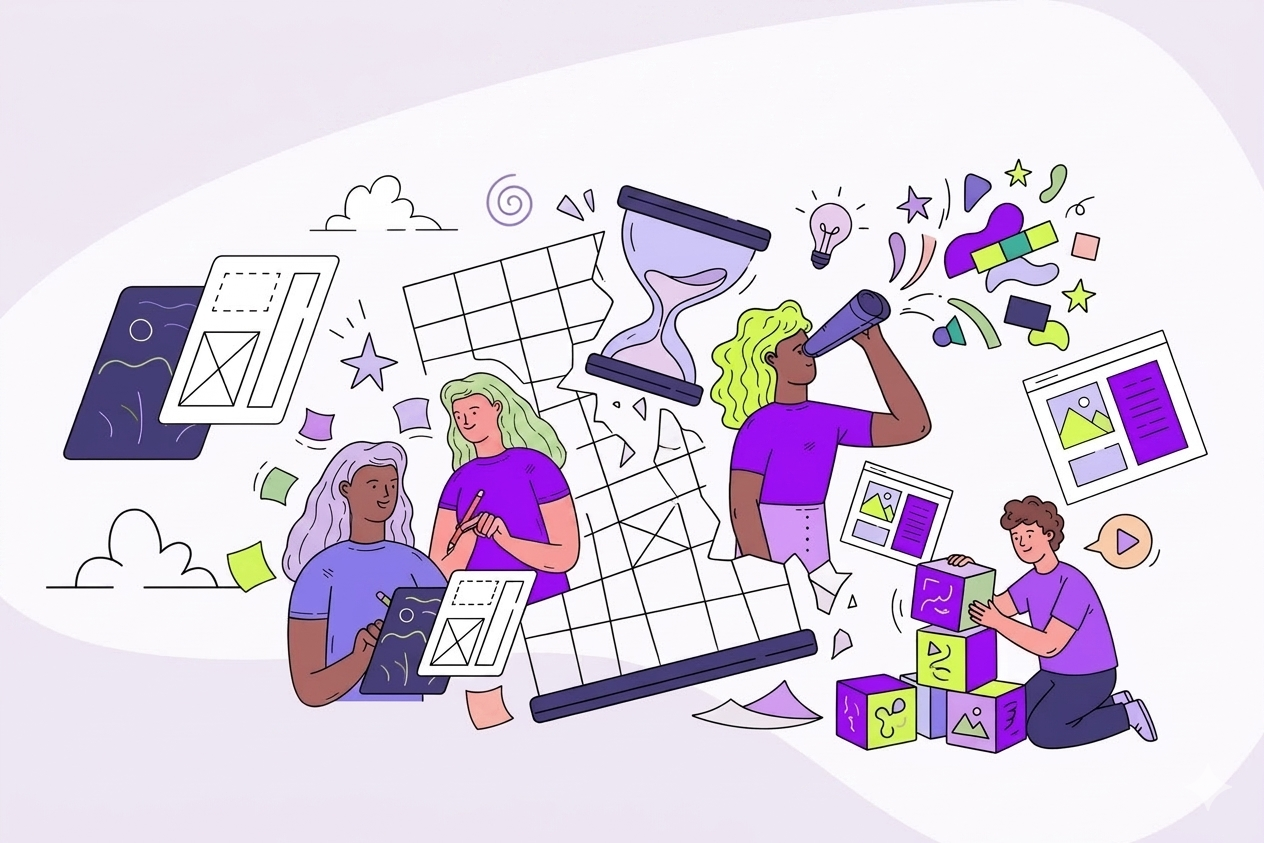
We’ve all seen it. A brief lands in the inbox, a designer does five minutes of "inspo" research, and before you can even grab a coffee, they’re already in Figma. They’re dragging components, snapping to grids, and following the design system to a T.
On paper, it looks productive. In reality? We’re losing the soul of what we do.
As design leaders, we’ve entered a hyper-productive era where the pressure from stakeholders to "ship fast" has turned designers into production lines. We’ve stopped playing. And when we stop playing, we stop innovating.
The "Table" Trap
Take the B2B space, for example. When a designer is asked to show complex data, the "obvious" answer is almost always a table. It’s safe, it’s in the library, and it’s what was done before.
But is a table actually the best way for a user to prioritise costs or track a task's status?
When we jump straight into high-fidelity tools, we’re just rearranging furniture in a room we haven't even built yet. We’re designing off the back of what’s already been created rather than thinking about what needs to exist.
Stepping Away from the Screen
To break this cycle, I’ve started forcing my team to go back to basics. If I see a design that feels "default," we step away from Figma and head to the whiteboard. This isn't just a break; it's a necessary mindset shift.
Abstract the Problem: We stop talking about UI and start talking about scenarios.
Role-Play the User: We literally walk through the day. "The user walks into work, they open this up…what is the one thing they are desperate to find?"
Ask the "Why": Why does this have to be a table? What if it were a visualisation? What if it wasn't a screen at all?
By sketching and abstracting, we open up a world of possibilities that a design system actually limits. We’re not just dragging boxes; we’re solving problems.
The Leader’s Responsibility: Creating Protected Space
You can’t tell a designer to "be creative" while breathing down their neck about a sprint deadline. Innovation requires protected time.
As leaders, we have to be deliberate. I make it a point to give my team creative briefs that have absolutely nothing to do with our day-to-day roadmap. It’s play for the sake of play.
No stakeholders, no KPIs – just a reminder that we are creative professionals, not just "Figma operators."
"If we just drag and drop what already exists, we aren't doing our jobs. We’re just filling templates."
My Advice for New Leaders
If you want to move your team from "production mode" to "innovation mode," try these three things:
Challenge the Obvious: When you see the "default" solution, ask for three more versions that look nothing like it.
Whiteboard First: Make it a rule that no one touches high-fidelity tools until the user's "moment of joy" or "point of friction" is mapped out manually.
Balance the Pressure: Protect your team from the stakeholder "need for speed." Carve out time where they are allowed to fail, mess up, and play with ideas that might never see the light of day.
Let’s stop just filling templates and start designing again. Our users –and our teams – deserve it.
Image created using Gemini